Showing posts with label pork. Show all posts

Tuesday, April 2, 2013

Spicy Baked Pasta with Bacon

Spicy Baked Pasta with Bacon

Several years ago, The Gastronomer went through a baked pasta phase, during which she came up with a number of fantastic variations on the winning formula of a sturdy pasta baked with a white, cheesy sauce and vegetables.  I've recently renewed the tradition with the version presented below, which is currently far and away The Gastronomer's favorite thing to eat for lunch at work.  Between the prep work, sautéing, sauce-making, baking, and inevitable scrubbing when the béchamel burns on the bottom of the pan [not sure why this keeps happening to me--seems like the only way to avoid it is to not quite let the milk boil...], the recipe takes a decent amount of work, but it's worth it because it will feed your family for a week (at least, it will if your family only has two people like ours does, and one of the people only eats the dish once...).  It strikes a great balance between healthy and rich, with plenty of flavor and spice.

Recipe adapted from "Two Pepper Rigatoni and Cheese" by Cooking Light, accessed via myrecipes.com.
  • 16 ounces uncooked whole wheat pasta (rigatoni, penne, or similar)
  • 8 ounces bacon (6 strips), sliced into 1/2" pieces
  • 1 medium white or brown onion, chopped
  • 10-12 ounces fresh spinach
  • 8 ounces frozen peas
  • 3 tablespoons all-purpose flour
  • 3 cups 1% milk
  • 1 cup (4 ounces) shredded jalapeno jack cheese 
  • 1 cup (4 ounces) shredded sharp cheddar cheese
  • 3-4 Thai chilis (or 2 jalapeno peppers), minced
  • 3/4 teaspoon salt
  • 1 tablespoon butter
  • 1 cup Panko breadcrumbs
Preheat oven to 375°.  Cook pasta in salted water until al dente, 1-2 minutes less than stated on package directions. Drain well; place in a large bowl.

Sauté bacon over medium-high heat until cooked through and slightly crisp.  Use a slotted spoon to transfer the bacon to the bowl with the cooked pasta.  Discard most of the bacon grease, saving approximately 1 tablespoon in the skillet for sautéing the onion.  Add the onion and cook over medium heat until it is tender and tastes mild and sweet.  Turn down heat and add spinach in bunches to the pan, stirring until it has cooked down.  Stir in frozen peas.  Transfer contents of skillet to the bowl with the pasta.

Spoon flour into a saucepan. Gradually add milk, stirring with a whisk until smooth. Bring to a boil; cook 2 minutes or until thickened, stirring constantly [as mentioned above, I've found that the milk/flour mixture always burns on the bottom of the pan during this step, even if I stir constantly with a whisk.  This doesn't affect the quality of the sauce, but cleanup is a pain.  Turning off the heat just before the milk boils helps, but I'll keep searching for other remedies.  Maybe our electric stove just adds heat too fast, or maybe it would be better to add butter like in a standard béchamel ...].  Remove milk from heat and add cheeses, stirring until cheeses melt and mixture is smooth. Stir in chilis and salt. Add cheese mixture to pasta, tossing well to coat.  Spoon pasta mixture into a 13 x 9–inch baking dish.

Melt butter in a small bowl. Add Panko breadcrumbs and toss until blended. Sprinkle breadcrumb mixture over pasta mixture. Bake at 375° for 15 minutes or until breadcrumb topping is golden brown.

Yield: 6 to 8 servings
Estimated Start-to-Finish Time: 40 minutes
Actual Start-to-Finish Time: 1 hour 45 minutes
Substitutions: There are many possible modifications one could make to this recipe.  We've tried several different cheese combos  (parmesan, fontina, etc.) with great success and used a number of different vegetables as well.  Most vegetables should be sautéed until they are tender before baking.  Homemade breadcrumbs can be used instead of Panko by following the original Cooking Light recipe.

Saturday, June 18, 2011

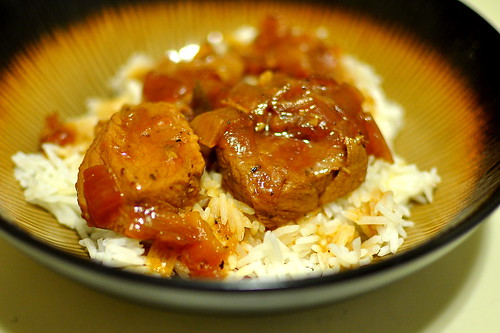
Filipino Pork Adobo

Pork Adobo

When I was drawing up the menus for The Gastronomer's 28th birthday meals back in February 2010, this recipe seemed like an ideal introduction to the "complete world of pork." It seemed straightforward and not too intimidating, and it was hard to imagine how it could fail to be delicious. Then last summer I was introduced to the wonderful pork adobo from Los Angeles's first Filipino food truck, The Manila Machine, and I became even more excited to try making Filipino-style adobo myself.

I managed to buy the Boston butt already chopped up as "stew meat", which made the prep a breeze. The adobo was a hit with the birthday girl, and I enjoyed feasting on it for lunch for the remainder of the week.

Recipe from Bruce Aidells's Complete Book of Pork.
  • 2 lbs boneless Boston butt, cut into 3-inch chunks
  • 1/2 cup rice or white vinegar, or more to taste
  • 3/4 cup light soy sauce
  • 1/4 Asian fish sauce (I used Squid brand, The Gastronomer's family's favorite)
  • 2 cups homemade chicken stock or canned low-sodium chicken broth or water
  • 2 teaspoons brown sugar, or more to taste
  • 2 teaspoons freshly ground black pepper
  • 4 bay leaves
  • 5 tablespoons chopped garlic
  • 2 onions, thinly sliced
  • 1 teaspoon Asian hot chili oil, or less/more to taste (I used Sriracha)
Put the pork and all of the remaining ingredients in a casserole or large saucepan and bring to a simmer over medium heat. Cook, uncovered, until the pork is tender, about 1 1/4 hours. Skim and discard the fat from the surface. Taste the broth and add more vinegar, sugar, or chili oil to balance the flavors to your liking. Serve the adobo over jasmine rice.

Yield: 4-6 servings
Estimated Start-to-Finish Time: Not given
Actual Start-to-Finish Time: 1 hour 45 minutes (30 minutes of active time)

Sunday, March 13, 2011

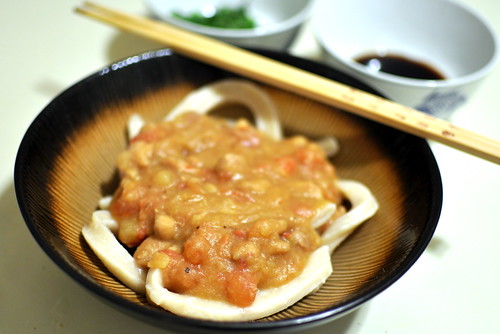
Homemade Noodles with Pork from Shanxi

Homemade Shanxi Knife Cut Noodles

In my first post about The Gastronomer's 2010 birthday meals, I mentioned that I was trying to seek out recipes that would that would push my limits as a cook. Making knife-cut Chinese noodles from scratch certainly qualifies. This recipe definitely has the potential to achieve the ideal Chinese noodle texture, although mine were a bit too square and thick. Next time I'll roll the dough out thinner. The pork mixture is awesome and could be served over fettuccini or linguine if you're not feeling so ambitious. I'm going to try making this one more time to perfect the consistency of the noodles, and then it's going onto the Brightest Stars list for sure!

Recipe by Susanna Foo Chinese Cuisine

For Noodles
  • 3 cups all-purpose flour
  • 1 cup cold water
  • 1 tablespoon corn oil
For Topping
  • 1 pound boneless lean pork, cut into 1/4-inch dice (this will retain its moisture when cooked better than finely ground meat)
  • 3 tablespoons soy sauce
  • 1 tablespoon corn starch
  • 3 tablespoons corn oil
  • 1/4 cup finely chopped onion
  • 3 garlic cloves, thinly sliced
  • 3 tablespoons brandy
  • 1 large russet potato, peeled and cut into 1/4-inch dice
  • 2 cups chicken stock
  • 2 large tomatoes, peeled and diced
  • 2 scallions, chopped
  • coarse salt
  • freshly ground pepper
Make Noodles

Place the flour in a large bowl and make a well in the middle. Pour the water into the well, stirring to incorporate the flour. Turn out onto a lightly floured work surface and knead by hand until smooth, about 5 minutes. Alternately, place the flour in a food processor and, with the motor running, add the water. Process until smooth, about 3 to 5 minutes.

Place the dough in a large bowl and cover with a damp towel, then loosely cover with a piece of plastic wrap and set aside at room temperature for 1 to 2 hours so the gluten in the dough relaxes.

Lightly flour the work surface and roll out the dough into a 1/4-inch-thick rectangle (or slightly thinner--I found that 1/4-inch x 1/4-inch noodles were a bit too thick). Sprinkle the surface of the dough lightly with flour and fold the rectangle in half to form another smaller rectangle. With a sharp knife, cut the dough into 1/4-inch wide strips. Place the noodles on a baking sheet. Sprinkle them lightly with flour and separate them with your hands. Cover with a towel.

Bring a large pot of water to boil, then add the oil and half of the noodles. Cook for 3 to 5 minutes, tasting one noodle to make sure the center is cooked but still firm to the bite. When the noodles are cooked, scoop them out of the water with a Chinese strainer or slotted spoon and place in a colander to finish draining. Repeat with the remaining noodles. Serve immediately.

Make Topping

While the dough is relaxing, begin preparing the topping. Place the diced pork in a large bowl and mix in the soy sauce and the cornstarch. Add 2 tablespoons of the oil, mix well, and marinate for a few minutes at room temperature while preparing the rest of the ingredients.

Heat 1 tablespoon of the oil in a large, heavy saucepan or Dutch oven. Add the onion and garlic and cook over high heat, stirring, until the onion is lightly browned, 2 to 3 minutes.

Add the pork, along with any marinade, and continue to cook, stirring, until the pork is no longer pink. Add the brandy. Cover the pot, turn the heat to medium and cook for about 10 minutes. Add the potato and mix well. Pour in the stock, cover, and cook for 30 minutes, or until the pork and potatoes are completely cooked.

Add the tomatoes and the scallions. Continue to cook, stirring often, for 3 minutes more, or until the sauce is thickened. Season with salt and pepper to taste. Spoon the pork sauce over the freshly cooked pasta and serve along with small bowls filled with any or all of the following optional garnishes: balsamic vinegar, chopped fresh jalapeno peppers, julienned cucumber, chopped fresh basil, chopped fresh cilantro, and julienned leeks.

Yield: 4-6 servings
Estimated Start-to-Finish Time: Not given
Actual Start-to-Finish Time: 3 hours

Monday, January 10, 2011

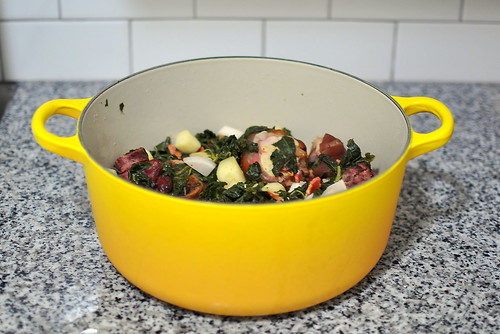
Braised Turnip Greens with Turnips and Apples

Braised Turnip Greens with Turnips and Apples

Although we appreciate fresh local produce and support small family farms in theory, The Gastronomer and I have a notoriously poor track record when it comes to finding our way to farmer's markets on the weekends. Thus I recently decided it was time for us to try a Community Supported Agriculture delivery program. When Christmas came around, along with the hilarious new Stuff White People Like book, I gave The Gastronomer a present to help us be better white people: a subscription to the South Central Farmers CSA co-op. As part of the gift, I promised that I would take charge of figuring out what to do with the bi-weekly bounty of fruit and vegetables.

I picked up our first box at a local church on the Sunday after New Years. We were excited to open it--I expected to find a variety of beautiful winter produce: apples, oranges, squash, brussels sprouts, kale, etc. What we got was a truly staggering quantity of leafy greens, and little else. The lone elements of color in the box came from a large turnip and a bunch of small radishes. It was a bit disappointing, and quite intimidating trying to imagine how we would ever find a way to use it all.

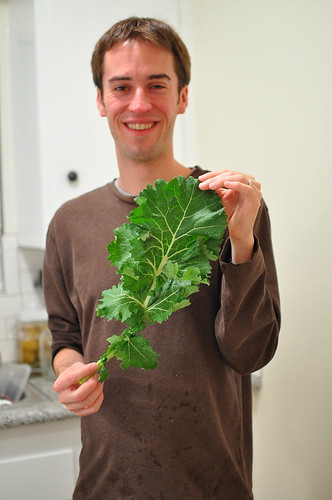
After a bit of research, we had identified all but one of the vegetables in the box, and had started to come across some enticing recipes. I started my farm-fresh cooking adventure by using the turnip and its greens in this recipe. It turned out to be a really fantastic way to get our vitamins while beginning to make a dent in the pile of greenery on our kitchen table. To reach something close to 2 lbs of greens, I added our entire stash of the mystery vegetable, which looked something like green chard but lacked its thick white stem.To help resolve the mystery of the leaf's identity, I'm breaking with tradition and publishing a Stellar Recipes post with two photos.

Mystery Green

Any ideas?

Recipe adapted from Gourmet, November 2009, courtesy of Epicurious.
  • 2 pounds turnip greens or other braising greens (kale, collards, etc.), tough stems discarded and greens torn into small pieces
  • 1 (3/4-to 1-pound) ham hock, rinsed
  • 3 1/2 cups water
  • 3 Gala apples
  • 1 1/4 pounds turnips, peeled and cut into 1/2-inch pieces
  • 2 teaspoons cider vinegar
  • 2 teaspoons sugar
  • 2 tablespoons unsalted butter, cut into pieces
Bring greens, ham hock, water, and 1/4 teaspoon salt to a boil in a large heavy pot. Reduce heat to low and simmer, covered, stirring occasionally, until greens are almost tender, about 20 minutes.

Meanwhile, peel apples and cut into 1/2-inch pieces.

Add turnips and apples to greens with vinegar, sugar, and 1/2 teaspoon each of salt and pepper and cook at a bare simmer, covered, stirring and turning ham hock occasionally, until turnips and apples are tender but not falling apart, about 20 minutes more.

Remove from heat and strain the liquid from the pot into another saucepan. Boil the liquid to reduce it to 1/3 or 1/4 of its original volume, then pour it back into the original pot with the greens. Stir in butter and salt to taste.

Remove ham hock and finely chop any tender meat, discarding skin, bone, and tough meat. Add chopped meat to pot.

Yield: 8 servings
Estimated Start-to-Finish Time: 1 hour
Actual Start-to-Finish Time: 2 hours. It took me forever to wash and tear up the huge quantity of greens--being fresh from the farm, they were quite dirty.
Substitutions: Boiling away some of the liquid was suggested by several reviewers on Epicurious. The dish would have been awfully watery otherwise.

Saturday, June 12, 2010

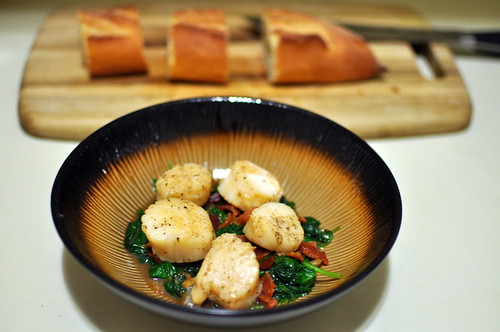
Seared Scallops with Bacon and Spinach

PAN-SEARED SCALLOPS WITH BACON AND SPINACH

When it's not a special occasion, I typically shy away from buying scallops because they're so darn expensive. However, I recently decided to give Trader Joe's frozen New England wild jumbo scallops a try. They're relatively reasonably priced, and my understanding is that most "fresh" seafood sold in grocery stores has in fact already been frozen and defrosted, so I figured they might be just as good. I wasn't disappointed--these were comparable in flavor and tenderness to scallops I've had in restaurants, if not quite as enormous (one pound was about 18 scallops). I wasn't really able to achieve the intended crispy sear because the skillet filled up with liquid once I put the scallops in---it was like sauteing tofu. I should have pressed the scallops dry more aggressively before cooking, but I suspect that my real problem was not quite giving them enough time to fully defrost in the fridge before cooking. However, I avoided overcooking them (priority #1 when working with scallops or shrimp), and they were still a pleasure to eat atop the delicious bed of bacon-infused spinach.

Recipe by Cooking Light, May 2010
  • 3 center-cut bacon slices
  • 1 1/2 pounds jumbo sea scallops
  • 1/4 teaspoon plus 1/8 teaspoon kosher salt, divided
  • 1/4 teaspoon freshly ground black pepper, divided
  • 1 cup chopped onion
  • 6 garlic cloves, sliced
  • 12 ounces fresh baby spinach
  • 4 lemon wedges (optional)

Cook bacon in a large cast-iron skillet over medium-high heat until crisp. Remove bacon from pan, reserving 1 tablespoon drippings in pan; coarsely chop and set bacon aside. Increase heat to high.

Pat scallops dry with paper towels. Sprinkle scallops evenly with 1/4 teaspoon salt and 1/8 teaspoon pepper. Add scallops to drippings in pan; cook 2 1/2 minutes on each side or until done. Transfer to a plate; keep warm. Reduce heat to medium-high. Add onion and garlic to pan; sauté 3 minutes, stirring frequently. Add half of spinach; cook 1 minute, stirring frequently. Add remaining half of spinach; cook 2 minutes or just until wilted, stirring frequently. Remove from heat; stir in remaining 1/8 teaspoon salt and remaining 1/8 teaspoon pepper.

Divide spinach mixture among 4 plates; top each serving evenly with crumbled bacon and 3 scallops. Serve immediately with lemon wedges and a toasted baguette.

Yield: 4 servings
Estimated Start-to-Finish Time: Not given
Actual Start-to-Finish Time: 1 hour 15 minutes
Substitutions: I went ahead and left all of the bacon fat in the skillet while cooking the other ingredients. In keeping with their mission, Cooking Light tends to avoid using any fats, salts, etc. that aren't absolutely necessary, but I figured it couldn't hurt to have everything taste extra bacon-y.

Tuesday, March 16, 2010

Castilian Stew

CASTILIAN STEW

When I originally drew up the menus for The Gastronomer's 2008 Christmas present, I intended for the final meal to culminate with chicken cordon bleu. At the time, wrapping one meat in another seemed like an appealingly extravagant conclusion to my series of culinary efforts. However, I somehow managed to forget that chicken is The Gastronomer's least favorite animal to eat, and besides, maybe the venerable dish was never all that cool to begin with...

A substitution had to be made, and with the weather cooling down, this Spanish stew from the Barcelona Wine Bar and Restaurants cookbook seemed like an ideal choice. Despite my bastardization of the recipe (see below), it turned out really well. I served the stew with rosemary cream biscuits from the The America's Test Kitchen Family Cookbook.

Recipe by The Barcelona Cookbook
  • 1/2 pound ham, finely diced
  • 1/2 pound slab bacon, finely diced
  • 2 cups diced smoked Spanish chorizo sausage (about 4 links)
  • 1/2 cup olive oil
  • 1/4 cup chopped garlic (one whole head)
  • 1/4 cup chopped red bell pepper
  • 2 cups canned tomatoes, drained
  • 3 russet potatoes, peeled and diced (2 1/2 to 3 cups)
  • 5 to 6 cups chicken stock
  • Salt and pepper
  • 6 cups chopped escarole or a similar green such as chard or kale (about 1/2 pound)
In a large pot, cook the ham, bacon, chorizo, and olive oil over medium heat for 8 to 10 minutes. Add the garlic and red pepper and cook for 7 to 8 minutes longer.

With your hands, squeeze the tomatoes to break them up and expel their juices. Add them to the pot along with the potatoes and enough stock to cover. Bring to a simmer over medium heat and cook for about 15 minutes, or until the potatoes are tender. Season to taste with salt and pepper.

Push the greens into the soup and cook for about 10 minutes, until the greens wilt and the soup is piping hot. Taste for seasoning and serve.

Yield: 4 hearty servings
Estimated Start-to-Finish Time: Not given
Actual Start-to-Finish Time: 2 hours 15 minutes
Substitutions: I wasn't able to buy smoked chorizo, so I ended up using three links of our favorite Italian hot sausage from Trader Joe's. No doubt this changed the character of the soup a bit, but the flavors still melded nicely. I bought a large bunch of swiss chard, and even though it was probably 8-9 cups, I threw it all in because I didn't know what else I'd do with the leftovers. This worked out fine--the stew had more than enough flavor to keep the overabundance of greens from stealing the show.

Tuesday, February 9, 2010

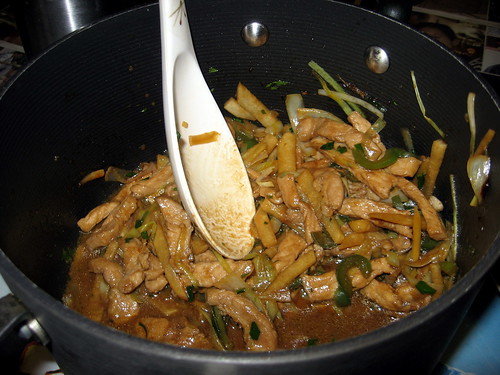
Mandarin Pork with Brandy-Infused Hoisin Sauce

MANDARIN PORK WITH BRANDY-INFUSED HOISIN SAUCE

A few posts back, I mentioned that I used to like Susanna Foo's restaurant in downtown Philadelphia. What I did not describe was how much I had to beg and plead to get The Gastronomer to go there with me. When she finally agreed to take me for my 22nd birthday, I eagerly anticipated a wonderful meal prepared by one of America's foremost Chinese chefs. However, as we dug into our appetizers, The Gastronomer couldn't resist raining on my parade with snide comments about "Chinese food for white people" that was five times more expensive but no more delicious than food from her favorite Chinatown haunts. She apologized immediately--she had no intention of tarnishing my birthday meal, but her feelings about how wrong it all was were simply too strong to be denied.

It was fortunate, then, that we ordered the moo shu pork as one of our entrees. When its subtle, perfectly balanced flavors hit our tongues, it was clear that we were experiencing something special--a serious step up from $6 Chinese food. It was truly one of the best dishes I'd ever tasted.

Thus, when I stumbled upon the following recipe in my Susanna Foo Chinese Cuisine cookbook and realized that it was essentially the same as her moo shu pork, I knew I absolutely had to give it a try. As expected, it was amazing. I served it with Susanna's scallion crepes for wrapping. A few months later, The Gastronomer and I made the recipe again using mock meat instead of pork, and it was once again excellent.

Recipe by Susanna Foo Chinese Cuisine

Brandy-Infused Hoisin Sauce
  • 2 tablespoons corn oil
  • 3 garlic cloves, minced
  • 2 cups (16-ounce jar) hoisin sauce
  • 2 tablespoons Asian sesame oil
  • 1/2 cup brandy
  • 2 tablespoons red wine or balsamic vinegar
  • 1/2 cup chicken, pork, or beef stock
Heat the oil in a medium saucepan. Add the garlic and cook over high heat, stirring, until it is golden, about 2 minutes. Be careful not to let the garlic brown.

Add the hoisin sauce and the sesame oil and bring to a boil, stirring constantly. Reduce the heat to medium, add the brandy and vinegar, and cook for 5 minutes, stirring constantly to keep the sauce from sticking to the pan. Add the stock and reduce the heat to low. Cook, stirring occasionally, for 15 minutes, until the sauce is well blended and thickened.

Cool the sauce and pour into a jar with a tight-fitting lid. This sauce will keep well, covered and refrigerated, for up to 1 month.

Mandarin Pork
  • 1/2 pound lean boneless pork loin
  • 1 small leek
  • 2 tablespoons brandy
  • 1 tablespoon soy sauce
  • 1 teaspoon cornstarch
  • 3 tablespoons corn oil
  • 1 tablespoon peeled, julienned gingerroot
  • 1/2 cup thinly sliced red bell pepper
  • 2 jalapeno peppers, cored, seeded, and julienned
  • 3 tablespoons Brandy-Infused Hoision Sauce
  • 1 cup finely julienned jicama
  • 1/4 cup chicken or pork stock
  • 1 tablespoon chopped fresh tarragon leaves
Cover the pork with plastic wrap and place in the freezer for 15 minutes; the semi-frozen meat will be easier to slice and julienne.

Cut off the root end of the leek, and peel off and discard the tough outer green leaves. Cut the leek into 2-inch sections. Cut each section in half lengthwise, the julienne. Wash well in cold water to remove any dirt. Drain and set aside.

Remove the pork from the freezer, cut into 1/8 inch slices, then julienne. Place the julienned pork in a shallow dish.

Combine the brandy and soy sauce in a small bowl. Pour over the pork and mix well. Sprinkle with the cornstarch, and using a fork or chopsticks, mix well to coat. Marinate for 15 minutes.

Heat the oil until it is hot in a large skillet or a wok. Add the pork, along with any marinade, and the gingerroot, and cook over high heat, stirring, for 2 minutes. Add the bell pepper and jalapeno peppers and cook, stirring, for 1 minute. Add the hoisin sauce and cook, stirring, for 2 minutes to coat the meat. Add the leek and the jicama.

Pour the stock into the skillet and cook, stirring, over high heat for 2 to 3 minutes, or until all the ingredients are heated through and the pork is cooked. Mix in the tarragon and serve.

Yield: 4 servings
Estimated Start-to-Finish Time: Not given
Actual Start-to-Finish Time: 1 hour 30 minutes
Substitutions: Susanna recommends using homemade chicken or pork stock, but it didn't seem worth it to me for this dish, so I just used store-brought chicken broth. Her dishes are labor-intensive enough as it is...
Related Posts with Thumbnails