Showing posts with label Chinese. Show all posts

Sunday, March 13, 2011

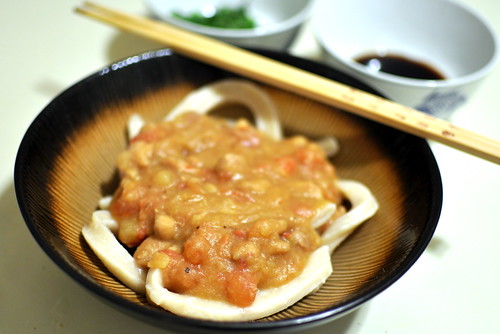
Homemade Noodles with Pork from Shanxi

Homemade Shanxi Knife Cut Noodles

In my first post about The Gastronomer's 2010 birthday meals, I mentioned that I was trying to seek out recipes that would that would push my limits as a cook. Making knife-cut Chinese noodles from scratch certainly qualifies. This recipe definitely has the potential to achieve the ideal Chinese noodle texture, although mine were a bit too square and thick. Next time I'll roll the dough out thinner. The pork mixture is awesome and could be served over fettuccini or linguine if you're not feeling so ambitious. I'm going to try making this one more time to perfect the consistency of the noodles, and then it's going onto the Brightest Stars list for sure!

Recipe by Susanna Foo Chinese Cuisine

For Noodles
  • 3 cups all-purpose flour
  • 1 cup cold water
  • 1 tablespoon corn oil
For Topping
  • 1 pound boneless lean pork, cut into 1/4-inch dice (this will retain its moisture when cooked better than finely ground meat)
  • 3 tablespoons soy sauce
  • 1 tablespoon corn starch
  • 3 tablespoons corn oil
  • 1/4 cup finely chopped onion
  • 3 garlic cloves, thinly sliced
  • 3 tablespoons brandy
  • 1 large russet potato, peeled and cut into 1/4-inch dice
  • 2 cups chicken stock
  • 2 large tomatoes, peeled and diced
  • 2 scallions, chopped
  • coarse salt
  • freshly ground pepper
Make Noodles

Place the flour in a large bowl and make a well in the middle. Pour the water into the well, stirring to incorporate the flour. Turn out onto a lightly floured work surface and knead by hand until smooth, about 5 minutes. Alternately, place the flour in a food processor and, with the motor running, add the water. Process until smooth, about 3 to 5 minutes.

Place the dough in a large bowl and cover with a damp towel, then loosely cover with a piece of plastic wrap and set aside at room temperature for 1 to 2 hours so the gluten in the dough relaxes.

Lightly flour the work surface and roll out the dough into a 1/4-inch-thick rectangle (or slightly thinner--I found that 1/4-inch x 1/4-inch noodles were a bit too thick). Sprinkle the surface of the dough lightly with flour and fold the rectangle in half to form another smaller rectangle. With a sharp knife, cut the dough into 1/4-inch wide strips. Place the noodles on a baking sheet. Sprinkle them lightly with flour and separate them with your hands. Cover with a towel.

Bring a large pot of water to boil, then add the oil and half of the noodles. Cook for 3 to 5 minutes, tasting one noodle to make sure the center is cooked but still firm to the bite. When the noodles are cooked, scoop them out of the water with a Chinese strainer or slotted spoon and place in a colander to finish draining. Repeat with the remaining noodles. Serve immediately.

Make Topping

While the dough is relaxing, begin preparing the topping. Place the diced pork in a large bowl and mix in the soy sauce and the cornstarch. Add 2 tablespoons of the oil, mix well, and marinate for a few minutes at room temperature while preparing the rest of the ingredients.

Heat 1 tablespoon of the oil in a large, heavy saucepan or Dutch oven. Add the onion and garlic and cook over high heat, stirring, until the onion is lightly browned, 2 to 3 minutes.

Add the pork, along with any marinade, and continue to cook, stirring, until the pork is no longer pink. Add the brandy. Cover the pot, turn the heat to medium and cook for about 10 minutes. Add the potato and mix well. Pour in the stock, cover, and cook for 30 minutes, or until the pork and potatoes are completely cooked.

Add the tomatoes and the scallions. Continue to cook, stirring often, for 3 minutes more, or until the sauce is thickened. Season with salt and pepper to taste. Spoon the pork sauce over the freshly cooked pasta and serve along with small bowls filled with any or all of the following optional garnishes: balsamic vinegar, chopped fresh jalapeno peppers, julienned cucumber, chopped fresh basil, chopped fresh cilantro, and julienned leeks.

Yield: 4-6 servings
Estimated Start-to-Finish Time: Not given
Actual Start-to-Finish Time: 3 hours

Monday, February 14, 2011

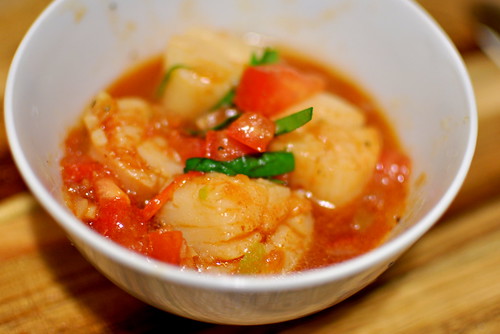
Cold Marinated Scallops

Susanna Foo's Cold Marinated Scallops

Susanna Foo Chinese Cuisine is well on its way to becoming the second unofficial cookbook of Stellar Recipes, joining the ever-reliable America's Test Kitchen Family Cookbook. Before serving poached pears for dessert during the first of The Gastronomer's 2010 birthday dinners, I made these scallops as a starter. Despite not being a tomato lover, I found them to be quite delicious, but The Gastronomer later told me she thought they were a bit too oily. Nevertheless, it's a very interesting recipe--I had never cooked with Bloody Mary mix before, and certainly never thought of mixing it with ginger, scallions, etc.

Recipe by Susanna Foo Chinese Cuisine
  • 1 pound medium sea scallops
  • 1/2 cup corn oil
  • 1 tablespoon fresh lemon juice
  • 1/4 cup diced onion
  • 1 tablespoon peeled, grated ginger root
  • 1/2 cup scallions, white part only, diced (about 3)
  • 1 small tomato, diced
  • 1/2 cup bottled Bloody Mary mix
  • Coarse salt
  • Freshly Ground Pepper
  • 1/4 julienned basil or cilantro leaves
Wash the scallops and pat dry. Place them in a single layer between sheets of paper towels until they are completely dry.

Heat the oil in a large skillet over high heat. When the oil is hot but not smoking, about 300 degrees F, add the scallops. Cook, turning, until the scallops are just cooked, about 3 minutes. Do not overcook, or they will toughen.

Using a slotted spoon, remove the scallops to a strainer and drain. Place them in a bowl, toss with the lemon juice, and refrigerate.

Remove all but 1 tablespoon of oil from the skillet and lower the heat to medium. Add the onion, gingerroot, and scallions. Cook, stirring, for 2 minutes. Turn off the heat, add the tomato and Bloody Mary mix, and stir to combine. Let the sauce cool.

Just before serving, drain the scallops. Spoon the sauce over them and toss to combine. Season to taste with salt and pepper. Garnish with the julienned basil or cilantro leaves and serve immediately.

Yield: 6 servings
Estimated Start-to-Finish Time: Not given
Actual Start-to-Finish Time: 2 hours

Saturday, February 20, 2010

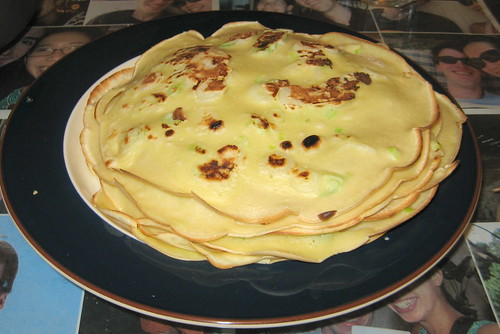
Scallion Crepes

SCALLION CREPES

These crepes from Susanna Foo Chinese Cuisine go wonderfully with Mandarin Pork with Brandy-Infused Hoisin Sauce, and they’re hard to resist eating alone too! They have a nice soft texture, with excellent flavor enhanced by the salt and scallions. I found that it was hard to get both sides of the crepes to look nice and golden brown (the appearance might have been improved if I had chopped the scallions smaller so that the batter was less lumpy), but the taste was right on.

Recipe by Susanna Foo Chinese Cuisine
  • 1 ½ cups all-purpose flour
  • 1 ½ cups water
  • 4 large eggs
  • 1 tablespoon coarse or kosher salt
  • 1 cup finely chopped scallions
  • About ½ cup corn oil for frying
Combine the flour, water, eggs, and salt in a food processor and process until all the ingredients are thoroughly combined. Pour the batter into a medium bowl. Or to mix by hand, whisk the water and eggs together in a large bowl, add the flour and the salt, and mix well.

Add the scallions and mix thoroughly.

Heat 1 tablespoon of the oil over medium heat in an 8-inch nonstick skillet. When the oil is medium-hot, ladle ¼ cup of the batter into the skillet. Tilt the pan so that the batter spreads evenly. Cook until the crepe is golden brown, 2 to 3 minutes, then turn and brown on the second side, about 2 minutes. Transfer to a platter and repeat, using the remaining batter and oil as needed.

Serve warm; the crepes are best when freshly made.

Yield: 10-12 crepes
Estimated Start-to-Finish Time: Not given
Actual Start-to-Finish Time: 40 minutes
Substitutions: I used vegetable oil to fry the crepes, which worked fine.

Tuesday, February 9, 2010

Mandarin Pork with Brandy-Infused Hoisin Sauce

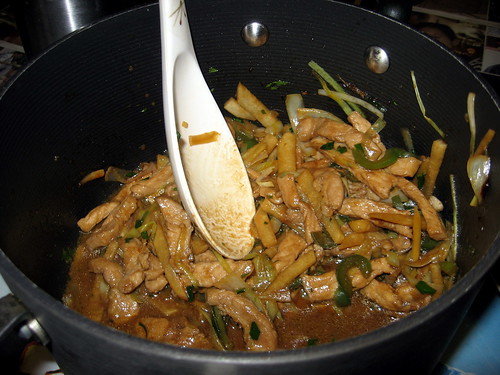
MANDARIN PORK WITH BRANDY-INFUSED HOISIN SAUCE

A few posts back, I mentioned that I used to like Susanna Foo's restaurant in downtown Philadelphia. What I did not describe was how much I had to beg and plead to get The Gastronomer to go there with me. When she finally agreed to take me for my 22nd birthday, I eagerly anticipated a wonderful meal prepared by one of America's foremost Chinese chefs. However, as we dug into our appetizers, The Gastronomer couldn't resist raining on my parade with snide comments about "Chinese food for white people" that was five times more expensive but no more delicious than food from her favorite Chinatown haunts. She apologized immediately--she had no intention of tarnishing my birthday meal, but her feelings about how wrong it all was were simply too strong to be denied.

It was fortunate, then, that we ordered the moo shu pork as one of our entrees. When its subtle, perfectly balanced flavors hit our tongues, it was clear that we were experiencing something special--a serious step up from $6 Chinese food. It was truly one of the best dishes I'd ever tasted.

Thus, when I stumbled upon the following recipe in my Susanna Foo Chinese Cuisine cookbook and realized that it was essentially the same as her moo shu pork, I knew I absolutely had to give it a try. As expected, it was amazing. I served it with Susanna's scallion crepes for wrapping. A few months later, The Gastronomer and I made the recipe again using mock meat instead of pork, and it was once again excellent.

Recipe by Susanna Foo Chinese Cuisine

Brandy-Infused Hoisin Sauce
  • 2 tablespoons corn oil
  • 3 garlic cloves, minced
  • 2 cups (16-ounce jar) hoisin sauce
  • 2 tablespoons Asian sesame oil
  • 1/2 cup brandy
  • 2 tablespoons red wine or balsamic vinegar
  • 1/2 cup chicken, pork, or beef stock
Heat the oil in a medium saucepan. Add the garlic and cook over high heat, stirring, until it is golden, about 2 minutes. Be careful not to let the garlic brown.

Add the hoisin sauce and the sesame oil and bring to a boil, stirring constantly. Reduce the heat to medium, add the brandy and vinegar, and cook for 5 minutes, stirring constantly to keep the sauce from sticking to the pan. Add the stock and reduce the heat to low. Cook, stirring occasionally, for 15 minutes, until the sauce is well blended and thickened.

Cool the sauce and pour into a jar with a tight-fitting lid. This sauce will keep well, covered and refrigerated, for up to 1 month.

Mandarin Pork
  • 1/2 pound lean boneless pork loin
  • 1 small leek
  • 2 tablespoons brandy
  • 1 tablespoon soy sauce
  • 1 teaspoon cornstarch
  • 3 tablespoons corn oil
  • 1 tablespoon peeled, julienned gingerroot
  • 1/2 cup thinly sliced red bell pepper
  • 2 jalapeno peppers, cored, seeded, and julienned
  • 3 tablespoons Brandy-Infused Hoision Sauce
  • 1 cup finely julienned jicama
  • 1/4 cup chicken or pork stock
  • 1 tablespoon chopped fresh tarragon leaves
Cover the pork with plastic wrap and place in the freezer for 15 minutes; the semi-frozen meat will be easier to slice and julienne.

Cut off the root end of the leek, and peel off and discard the tough outer green leaves. Cut the leek into 2-inch sections. Cut each section in half lengthwise, the julienne. Wash well in cold water to remove any dirt. Drain and set aside.

Remove the pork from the freezer, cut into 1/8 inch slices, then julienne. Place the julienned pork in a shallow dish.

Combine the brandy and soy sauce in a small bowl. Pour over the pork and mix well. Sprinkle with the cornstarch, and using a fork or chopsticks, mix well to coat. Marinate for 15 minutes.

Heat the oil until it is hot in a large skillet or a wok. Add the pork, along with any marinade, and the gingerroot, and cook over high heat, stirring, for 2 minutes. Add the bell pepper and jalapeno peppers and cook, stirring, for 1 minute. Add the hoisin sauce and cook, stirring, for 2 minutes to coat the meat. Add the leek and the jicama.

Pour the stock into the skillet and cook, stirring, over high heat for 2 to 3 minutes, or until all the ingredients are heated through and the pork is cooked. Mix in the tarragon and serve.

Yield: 4 servings
Estimated Start-to-Finish Time: Not given
Actual Start-to-Finish Time: 1 hour 30 minutes
Substitutions: Susanna recommends using homemade chicken or pork stock, but it didn't seem worth it to me for this dish, so I just used store-brought chicken broth. Her dishes are labor-intensive enough as it is...

Thursday, February 4, 2010

Braised Tofu in Caramel Sauce

BRAISED TOFU IN CARAMEL SAUCE

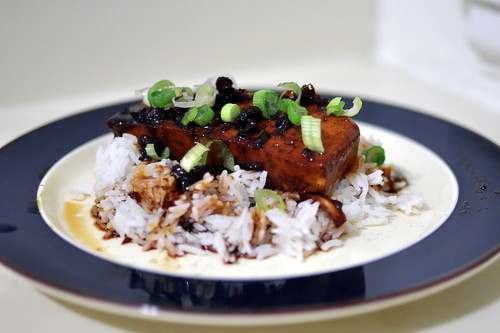
I absolutely love sweet Chinese sauces, so when The Gastronomer saw this recipe on The New York Times website, she knew it was perfect for me. This was my first foray into caramelizing sugar; unfortunately I haven’t quite mastered it yet. The first time I cooked it a bit too long and the end product tasted slightly burnt, while the second time I was overly conservative and ended up with a sauce that was tasty but ridiculously sweet. It didn’t help that descriptions in the recipe weren’t terribly clear.

Despite my imperfect sauce, we enjoyed the dish and were impressed by how well the tofu soaked up the flavors. The Gastronomer makes caramelizing look so easy when she makes Vietnamese thit kho—I suppose I’ll learn eventually.

Recipe by The New York Times Magazine
  • 1 1-pound block firm tofu
  • 1 cup white sugar
  • 5 shallots, peeled and minced
  • 4 cloves garlic, peeled and minced
  • 2 tablespoons peeled and minced ginger
  • 3 tablespoons soy sauce
  • 1/2 bunch scallions, white and light-green parts only, thinly sliced
  • Freshly ground black pepper
  • Cooked jasmine rice, for serving (optional).
Slice the tofu in half along its length and then each portion into two thick slices. Place the slices between paper towels to drain, replacing towels as needed.

Meanwhile, dissolve the sugar in 1/4 cup water and cook in a small saucepan over medium-low heat until small bubbles begin to appear around the edges of the pan. Carefully swirl the solution, but do not stir. Continue to heat, as bubbles move inward toward the center of the pan [it didn't happen like this when I made it] and the solution turns darker, 20 to 35 minutes, until the syrup has become a deep, golden caramel color. Carefully add 1/2 cup water to this mixture. (It will sputter violently. If some sugar crystallizes at this point, carefully stir the mixture with a metal spoon. The sugar will remelt.) Turn off the heat and allow to cool slightly.

Transfer the caramel sauce to a wide saucepan, turn the heat to medium and add the shallots, cooking for about 2 minutes. Add the garlic and ginger and stir again, cooking for about 1 minute. Now stir in the soy sauce. Simmer and stir until the mixture is viscous and the vegetables are well coated, about 10 minutes.

Place the tofu in the sauce in a single layer and simmer uncovered for 7 minutes. Using a spatula, turn the pieces over. Simmer for 3 or 4 minutes more and then transfer to a warmed platter. Pour the sauce over the tofu and sprinkle with scallions and black pepper. Serve with white rice.

Yield: 4 servings
Estimated start-to-finish time: Not given
Actual start-to-finish time: 1 hour 30 minutes
Substitutions: I used onions instead of shallots and cooked them for 4 minutes instead of 2 to make sure their flavor wasn't too sharp.

Friday, January 29, 2010

Water Chestnut, Arugula, and Endive Salad

WATER CHESTNUT SALAD

Back when I lived in Philadelphia, my aunt learned that I liked Susanna Foo’s restaurant and gave me two of her cookbooks for Christmas. More than two years later, I still had not attempted a recipe from the books—in my inexperienced, cautious state, attempting to replicate the offerings of a high-end Chinese restaurant simply seemed like too intimidating a challenge. Finally this past spring, after building confidence by allowing the America’s Test Kitchen’s chefs to hold my hand through the preparation of a series of three-course meals, I felt ready to attempt a Susanna Foo dinner.

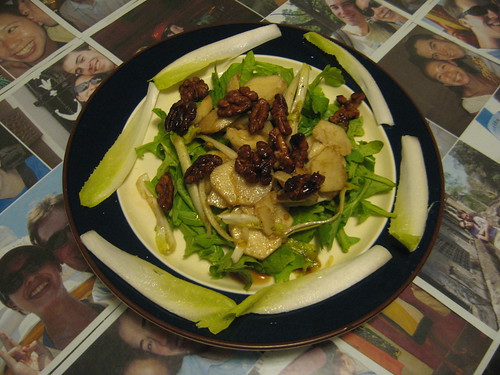
After reading Susanna’s glowing feature on raw fresh water chestnuts, I decided to tackle this salad first. Indeed, the water chestnuts made the dish—they really are something special. If you’ve never tried them, go to a Chinese grocery store and look for small, hard brown fruits covered in dirt. Avoid any that have soft spots, as it means that they are bruised and going bad. Wash them and then peel with a paring knife. They can be stored, peeled, in a bowl of water in the fridge for 1-2 weeks.

The “honeyed” walnuts in this recipe are disproportionately labor intensive. They have a light, crispy texture and unique flavor, and they definitely add to the total package, but you could make a respectable salad with plain old toasted walnuts and save yourself a lot of time.

Recipe by Susanna Foo Chinese Cuisine

“Honeyed” Walnuts
  • 1 pound shelled walnut halves
  • 1 ½ cup sugar
  • About 1 ½ cups water
  • 2 tablespoons corn oil (vegetable oil works fine)
  • Wash the walnuts in lots of running water. Soak them for 10 to 15 minutes in water to cover; drain well.
Fill a large pot with water and bring to a boil. Add the nuts and cook for 10 minutes, or until the water turns dark and the nuts are beige-white in color. Drain and rinse under cool water until the water runs clear; drain.

Bring the sugar and 1 ½ cups water to boil in a medium pot over medium-high heat, stirring to dissolve the sugar. Add the walnuts, reduce the heat to low and stir well with a wooden spoon. Simmer the nuts in the syrup for about 15 minutes, stirring often, until they are well-coated with the syrup. Add ¼ cup hot water if the syrup becomes too sticky. Turn off the heat and let the nuts cool in the syrup for another 10 minutes.

Preheat the oven to 350 degrees F. Strain off the excess syrup and toss the nuts with the oil. Spread the nuts on a large nonstick baking sheet. Bake for 30 to 35 minutes, stirring occasionally, or until they are crisp and dry. If they are not yet crisp, bake them a little longer.

The nuts can be stored in a tightly closed container at room temperature for 1 to 2 days or frozen in a sealed plastic bag for up to 3 months.

Water Chestnut, Arugula, and Endive Salad

For Dressing:
  • 3 tablespoons extra-virgin olive oil
  • 2 tablespoons balsamic vinegar
  • 1 teaspoon peeled, minced gingerroot
  • 1 teaspoon coarse or kosher salt
  • Freshly ground pepper
For Salad:
  • 1 pound fresh water chestnuts, peeled and washed
  • 2 Belgian endives
  • ¼ pound tender baby arugula, stems removed, washed and dried
  • ½ cup “Honeyed” Walnuts (optional; the above recipe will make much more than this)
  • 1 tablespoon minced fresh chervil leaves, for garnish (optional)
Combine all of the ingredients for the vinaigrette and stir well to blend. Set aside.

Cut each water chestnut into thin slices and set aside in a bowl of cold water until needed, to keep them from turning brown.

Cut off the stem end of the Belgian endives. Remove the large outer leaves (you will need 12 of them). Cut each leaf in half lengthwise and place in a large bowl filled with ice water to crisp the leaves. Julienne the remaining smaller inner leaves and immerse them in another bowl of ice water.

Just before serving, drain and dry the water chestnuts and the julienned endive. Place them in a bowl, add the vinaigrette, and mix well.

Place 4 of the halved endive leaves around the perimeter of each of 6 salad plates. Mound some arugula in the center of each plate. Spoon the water chestnut mixture over the top and garnish with the walnuts, if using. Decorate with the chervil leaves, if using.

Yield: 6 servings
Estimated Start-to-Finish Time: Not given
Actual Start-to-Finish Time: 1 hour 45 minutes
Related Posts with Thumbnails